Oklahoma Lyrics: Song List
- Act 1
- Overture
- Oh, What a Beautiful Morning
- Laurey's Entrance
- Surrey With the Fringe on Top
- Kansas City
- I Cain't Say No
- Many a New Day
- Many A New Day Ballet
- It's a Scandal! It's a Outrage!
- People Will Say We're in Love
- Pore Jud Is Daid
- Lonely Room
- Out of My Dreams
- Act 2
- Farmer and the Cowman
- All Er Nothin'
- People Will Say We're in Love (Reprise)
- Oklahoma!
- Finale: Oh, What A Beautiful Mornin'
About the "Oklahoma" Stage Show
The musical is based on the play "Green Grow the Lilacs" by Lynn Riggs. Composer – Richard Rodgers. Screenwriter – Oscar Hammerstein II. Trials were held in March 1943 at the Shubert Theatre stage. After renaming the musical and making it in a new way, the spectacular was shown on Broadway. The play was on stage of St. James Theatre from March 1943 to May 1948, with 2212 performances. Directed by Rouben Mamoulian. Choreographed by Agnes de Mille. The cast included Alfred Drake, Joan Roberts, Celeste Holm, Howard Da Silva, Betty Garde, Lee Dixon, Joseph Bulloff, Joan Lawrence, Marc Platt, Katharine Sergava & Vladimir Kostenko.
The London premiere took place in April 1947 at the Theatre Royal. The show concluded in May 1950 after 1543 performances. Directed by Rouben Mamoulian, choreographed by Agnes de Mille. The cast included Howard Keel, Betty Jane Watson, Dinah MacFarland, Harold Clarke, Marion Marlowe, Walter Donahue & Marie Windheim. In April 1947, the musical was also held at the Manchester Opera House.
In May 1951, it was staged at the Broadway Theatre for 100 performances. The cast included Patricia Northrop, Ridge Bond, Harold Clarke & Jack Sundt. In 1953, 40 performances took place at NY’s City Center with Florence Henderson, Ridge Bond, and Barbara Cook. The new version of the production was held at the Palace Theatre from December 1979 to August 1980, directed by William Hammerstein, choreographed by Gemze de Lappe. A new variant was shown in the West End in 1980 and during 1998 – 2003, in London's George Gershwin Theatre. The musical received several Theatre World, Tony, Drama Desk, and other awards.
Recently, "Oklahoma!" experienced a significant revival that brought fresh interpretations to this classic. In 2019, the Broadway revival, directed by Daniel Fish, won the Tony Award for Best Revival of a Musical. This production offered a darker, more intimate reimagining of the original, featuring contemporary orchestrations and innovative staging. The cast included Damon Daunno, Rebecca Naomi Jones, Mary Testa, and Ali Stroker, who made history as the first actor in a wheelchair to win a Tony Award.
Additionally, "Oklahoma!" has continued to tour internationally, with productions in countries like Australia and Japan, further solidifying its status as a timeless piece of American musical theatre. The success of the recent revivals and tours has proven that "Oklahoma!" remains relevant, resonating with modern audiences while celebrating its rich legacy.
Release date of the musical: 1943
"Oklahoma!" – The Musical Guide & Song Meanings
Review
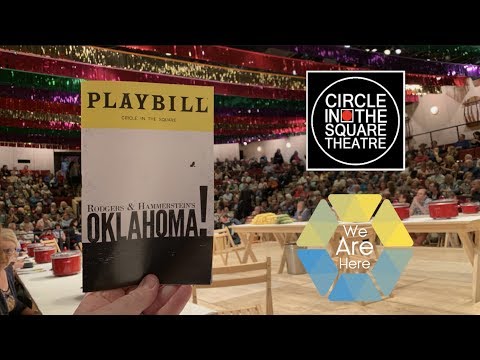
How does a show that opens with pure morning optimism also end up arguing, quietly but relentlessly, about who gets absorbed into a community and who gets erased by it? That tension is the engine of Oklahoma! and it is why the lyrics still matter more than the prairie-postcard plot summary. Hammerstein’s writing does two jobs at once: it sells romance with teasing restraint, then flips the lens toward coercion and loneliness without changing vocabulary. The result is that the score can sound like a wide-open sky while the text keeps noticing the fence line.
Listen closely and you hear a lyrical strategy that feels simple until it doesn’t. “People Will Say We’re in Love” is a rulebook duet disguised as flirtation; it turns denial into foreplay and foreshadows how the town will later rewrite what it sees. Jud’s material is the inverse: less clever, more blunt, full of self-narration that the community refuses to validate. The musical language supports the split. In the classic orchestral frame the melodies carry a warm, hymn-like confidence; in later re-orchestrations (especially the 2019 cast recording), the band-forward twang makes the same words land with vernacular bite, like folk memory you can’t romanticize away.
How It Was Made
Oklahoma! began as an adaptation of Lynn Riggs’s play Green Grow the Lilacs, pulled back into focus when Theatre Guild producer Theresa Helburn saw its potential and started nudging composers toward it. That push eventually landed with Rodgers and Hammerstein, whose first collaboration looked risky on paper and ended up resetting the industry’s expectations for what a “book musical” could do with integrated song and story.
The most radical choice was not a lyric tweak. It was choreographic psychology. Agnes de Mille’s dream ballet turns Laurey’s interior life into staged argument, making subtext physical and letting fear compete with desire in real time. The Rodgers & Hammerstein organization has noted how the dream’s anxieties seem to “conjure” Jud into the waking scene, which is exactly the point: the show doesn’t treat dread as a side plot. It treats it as a plot motor.
Key Tracks & Scenes
"Oh, What a Beautiful Mornin’" (Curly)
- The Scene:
- The stage is almost bare. Morning light does most of the scenery work. Curly arrives like a man confident the world will harmonize around him.
- Lyrical Meaning:
- This is not just weather. It is Curly announcing a worldview: optimism as entitlement. Hammerstein’s plain diction is the trick; it dares you to trust him before the show complicates what “everything’s goin’ my way” costs other people.
"The Surrey with the Fringe on Top" (Curly, Laurey, Aunt Eller)
- The Scene:
- Curly comes calling to invite Laurey to the social. The air is domestic, slightly tense. As he describes the surrey, the scene turns cinematic, like the room has widened into a road.
- Lyrical Meaning:
- A seduction by detail. The lyric sells romance through inventory: fringe, leather, horses, speed. It is persuasion as pastoral advertising, which fits a territory learning to brand itself into a state.
"People Will Say We’re in Love" (Curly, Laurey)
- The Scene:
- Two people circling each other with fake rules. The lighting can stay gentle; the tension lives in the pauses, not the volume.
- Lyrical Meaning:
- Hammerstein writes a duet of denials that function as admissions. The “don’t” list creates an intimacy contract, and it doubles as social camouflage: they’re rehearsing how to be seen without being exposed.
"Kansas City" (Will, Aunt Eller, Ensemble)
- The Scene:
- Will returns from town with a salesman’s grin and a tourist’s amazement. The pace lifts. The stage becomes a bragging postcard.
- Lyrical Meaning:
- Modernity as rhythm. The lyric is a catalog of noise and novelty that lets the musical widen beyond the farm, while also mocking the idea that progress is automatically sophistication.
"Lonely Room" (Jud)
- The Scene:
- Jud alone, enclosed, the air heavy. Even in traditional stagings, this number wants lower light and tighter space than the rest of the show.
- Lyrical Meaning:
- Jud doesn’t charm the audience into empathy; he argues for it. The lyric is self-mythologizing and self-accusing at once, the closest Oklahoma! gets to a confession without absolution.
"Pore Jud Is Daid" (Curly, Jud)
- The Scene:
- Curly visits Jud in the smokehouse and sings an imagined funeral. The mood is playful on the surface, but the room should feel unsafe, because it is.
- Lyrical Meaning:
- A community weaponized into a lullaby. Curly narrates the respect Jud would finally get if he disappeared, and the rhyme makes cruelty easy to swallow. This is where the lyric’s folksiness becomes an ethical problem the show never fully resolves.
"Out of My Dreams" / Dream Ballet (Laurey, Ensemble)
- The Scene:
- Laurey takes a potion and slips into a stylized nightmare: doubles, dancers, heightened colors, desire turning predatory. The dream should feel like the plot’s subconscious taking over stage management.
- Lyrical Meaning:
- The lyric hands off to movement because words would tidy the mess. The dream sequence externalizes Laurey’s fear of choosing wrong, and it makes explicit that romance here is never separate from threat.
"Oklahoma!" (Company)
- The Scene:
- A public celebration, bright on paper, uneasy in practice. It is a song that plays like a civic anthem while the story asks what the civic story is hiding.
- Lyrical Meaning:
- A hymn to belonging that doubles as a loyalty test. The lyric is big enough to carry joy, but also broad enough to exclude anyone the community decides is “other.”
Live Updates
Information current as of January 2026. The Daniel Fish revival’s West End run at Wyndham’s ended in 2023, and the rights ecosystem has kept the title busy across professional, youth, and regional pipelines. A notable 2026 marker: Tulsa Performing Arts Center has announced an in-house production running July 24 to August 16, 2026, a reminder that Oklahoma! remains a civic-event musical in cities that want a classic with edge and scale.
On the listening side, the catalog is unusually healthy for a 1943 score. If you want the modern, re-orchestrated sound world, the Oklahoma! (2019 Broadway Cast Recording) stays the cleanest single entry point on major streamers. For historical impact, the original 1943 cast recording is still treated as a landmark recording industry moment, with institutional documentation that frames its early-December 1943 release as a turning point for cast albums as a consumer category.
Notes & Trivia
- Early tryouts used the title Away We Go! before the show adopted the name of its final anthem.
- The 1943 Broadway run reached 2,212 performances, a scale that signaled a new commercial ceiling for integrated musicals.
- Myth-check: the dream ballet is not decorative “extra dance.” It is narrative psychology that re-positions Jud as a conjured fear, not a random villain.
- The Rodgers & Hammerstein organization documents extraordinary demand for the first cast album release, framing it as a retail event with major advance orders.
- The 1955 film soundtrack became a chart force and stayed on album charts for an unusually long stretch, later earning major sales certifications.
- If you are seeing a revival in an intimate space, pick seats that keep faces readable. This show’s moral shifts happen in expressions, not scenic spectacle.
Reception
The original production arrived during wartime and quickly became a consensus hit, helped by the shock of that opening number: a musical that began like real life, not like a chorus line. Later revivals have triggered a more divided conversation, because the text always contained darkness and directors now choose whether to underline it or soothe it.
“A dark and dangerous directorial vision presents this classic treasure ... in a fresh but far from sunny new light.”
“Atmosphere ... and the uneasy sense that all is not quite well are crucial to Fish’s vision of Oklahoma!”
The revival reframes the finale as communal denial, letting the familiar anthem land with irony rather than comfort.
Quick Facts
- Title: Oklahoma!
- Year: 1943 (Broadway premiere)
- Type: Book musical
- Music: Richard Rodgers
- Book & Lyrics: Oscar Hammerstein II
- Source Material: Green Grow the Lilacs by Lynn Riggs
- Original Broadway Venue: St. James Theatre
- Signature staging device: Agnes de Mille dream ballet
- Key recordings: Original 1943 cast recording (Decca); 1955 film soundtrack (Capitol); 2019 Broadway cast recording (Decca Broadway)
- 2019 revival music leadership: Daniel Kluger (orchestrations/arrangements; musical supervision)
- Availability notes: Major recordings remain widely available on streaming and in reissues; the 2019 cast recording is a current-sound entry point.
Frequently Asked Questions
- Is there a movie version?
- Yes. The best-known film adaptation is the 1955 movie, which generated a hugely successful soundtrack album and helped lock these songs into popular culture.
- Who wrote the lyrics?
- Oscar Hammerstein II wrote the lyrics and the book, with music by Richard Rodgers.
- Why does “People Will Say We’re in Love” sound like a list of rules?
- Because it is. The lyric turns denial into a flirtation framework, letting the characters admit feelings while pretending they are policing them.
- What is the dream ballet doing in the middle of the story?
- It stages Laurey’s conflict without dialogue: desire, dread, and social pressure collide. It is a narrative decision tool, not a decorative dance break.
- Which album should I start with?
- If you want a contemporary sonic profile, start with the 2019 Broadway cast recording. If you want historical context, start with the early-December 1943 original cast recording that helped define the cast-album market.
Key Contributors
| Name | Role | Contribution |
|---|---|---|
| Richard Rodgers | Composer | Melodic architecture that can read as pastoral comfort or latent menace, depending on orchestration. |
| Oscar Hammerstein II | Lyricist / Book | Plainspoken lyrics that carry social pressure, romance, and exclusion in the same vocabulary. |
| Agnes de Mille | Choreographer | Dream ballet concept that turns interior conflict into plot-driving stage language. |
| Daniel Fish | Director (revival) | Modern revival framing that foregrounds community complicity and the show’s darker undertones. |
| Daniel Kluger | Orchestrations / Arrangements | Reduced-band reorchestration that shifts the score toward vernacular country textures. |
Sources: Rodgers & Hammerstein Official Site; IBDB; Playbill; The New Yorker; The Guardian; Concord Theatricals; Library of Congress (National Recording Registry); LondonTheatre; American Theatre (magazine); Tulsa Performing Arts Center.