
Brooklyn Lyrics: Song List
- Good Crowd Goin'
- Heart Behind These Hands
- Thank You, Sir
- Scene One
- Christmas Makes Me Cry
- Not A Sound
- Brooklyn Grew Up
- Creating Once Upon A Time
- Once Upon A Time
- Witness to History
- Superlover
- Challenge
- Brooklyn In The Blood
- Brooklyn Grew Up (Reprise)
- Magic Man
- Once Upon A Time (Reprise)
- Love Was A Song
- I Never Knew His Name
- Truth
- Does Anybody Wanna Buy A Memory?
- Raven
- Sometimes
- Madison Square Garden
- Love Me Where I Live
- Love Fell Like Rain
- Magic Man (Reprise)
- Streetsinger
About the "Brooklyn" Stage Show
Jeff Calhoun was the director of this musical on Broadway, which opened at late October 2004. One of the creators of the musical was Gerald Schoenfeld and, whether for services, whether because he was too generous in sponsorship, the theater was named after him after only a year from the start of the show. The original name of the theater was a Plymouth Theatre. Total 284 performances – that was the verdict of the public, who took this production quite restrained. Impressive 27 previews did not help in going further. According to the criteria of the current time, this number of the show reflects the overall lack of success and fun enough only for a couple of seasons. Actors were the following: C. Derricks, K. Olivo, R. Keller, K. Anderson & E. Espinosa.
However, despite the dim performance on Broadway, the musical began a national tour on cities in 2006, with this composition of the actors: L. Morgan, D. DeGarmo, C. Derricks, M. Moore & J. Reiber.
Recording the music on CD took place between 2004 and 2006.
In 2008, the city Janesville took the play for 2 months, with this set of actors: A. Linden, E. Samsel, D. Seward, J. Edwards, J. M. Eberhart, B. J. Frazier & C. Waller. In the same year, 14th Street Theatre, in Ohio, shown the production in a town called Berea – it was staged by the local college.
The musical also came to the capital of Brazil, to São Paulo, in 2012.
Release date of the musical: 2004
“Brooklyn” – The Musical Guide & Song Meanings
Review
What kind of musical starts with homelessness and ends at Madison Square Garden. Brooklyn tries to answer that question by framing fame as a fairy tale you can rent by the minute. The show’s engine is a “story within a story”: the City Weeds, a band of street performers, build a make-believe stage at the foot of the Brooklyn Bridge and tell us about a Parisian singer named Brooklyn chasing a father, a future, and a name that feels like a prophecy.
The lyric writing has a distinct habit. It announces itself. It likes headings in musical form: big feelings, bold turns, declarative hooks. When it works, that directness is the point. This is a fable. Fables speak in neon. When it doesn’t work, the words can feel like they’re pushing the audience toward an emotion the performers are already earning.
Musically, Schoenfeld and McPherson sit in a 2000s pop-theatre pocket: rock edge, gospel lift, and power-ballad architecture designed for a voice to climb. The score understands the allure of the spotlight, then keeps cutting back to the street corner that created the spotlight in the first place. The show’s sharpest idea is structural, not melodic: every time Brooklyn gets closer to “success,” the framing reminds you someone else is still outside the story, still busking for dinner.
How It Was Made
The origin story is unusually literal. Barri McPherson and Mark Schoenfeld had worked together years earlier, lost touch, then reconnected after McPherson spotted Schoenfeld singing on a Brooklyn street corner. That collision became the seed: songs shaped by street survival, then expanded into a full plot and a Broadway pitch.
Before Broadway, the musical tested its legs in Denver in 2003, an early proving ground that kept Eden Espinosa in the title role as the piece evolved. The Broadway production arrived in fall 2004, directed by Jeff Calhoun, and leaned into a theatrical contradiction: a show about a homeless community selling the fantasy of stardom, night after night, in one of the most expensive neighborhoods on earth.
The cast album choice says a lot about intent. Instead of a sealed, studio-perfect document, the team released a live recording “in front of an invited audience,” keeping applause and crowd heat in the tracks. It’s a brand decision and a storytelling decision. The show wanted you to hear the street corner as an event, not as a polished museum piece.
Key Tracks & Scenes
The production is built as a sequence of framed episodes: street corner under the bridge, then the City Weeds “stage” scenes in a convent, a career ascent, a hunt for Taylor, and a public showdown with Paradice. These highlights track the score’s most plot-driving lyric moments rather than listing every number.
“Heart Behind These Hands” (The City Weeds)
- The Scene:
- First contact. A rough street-corner setup becomes a makeshift theatre. The ensemble establishes its rules: we tell stories here, because the city won’t tell ours.
- Lyrical Meaning:
- This is the show’s mission statement. The lyric frames performance as labor and as proof of life. It argues that what’s “in your hands” is also what you’re allowed to keep.
“Once Upon a Time” (Brooklyn and The City Weeds)
- The Scene:
- The fable begins in earnest. Brooklyn’s myth gets built in front of us, with the City Weeds shaping the narrative like a chorus that can’t resist a good story.
- Lyrical Meaning:
- The hook is intentionally storybook. “Once upon” is not innocence here, it’s strategy. The lyric is Brooklyn choosing to believe in the version of her life that might save her.
“Superlover” (Paradice and The City Weeds)
- The Scene:
- Paradice enters as a self-authored headline. The number plays like a club set dropped into a sidewalk narrative, a reminder that power knows how to perform.
- Lyrical Meaning:
- Paradice sings seduction as dominance. The lyric posture is control: admiration as currency, desire as leverage. It sets up why she sees Brooklyn as a threat, not a peer.
“I Never Knew His Name” (Brooklyn)
- The Scene:
- A private confession inside a public story. Brooklyn turns the search for Taylor into something more painful: the search for language to describe what she’s missing.
- Lyrical Meaning:
- The line between identity and information collapses. Not knowing a name becomes not knowing where you belong. The lyric makes absence feel like a physical object she’s carrying.
“Love Was a Song” (Taylor)
- The Scene:
- We finally meet the father as a broken promise. Taylor’s section reframes the fairy tale in adult terms: war damage, addiction, regret.
- Lyrical Meaning:
- The lyric treats love as something already finished, already past tense. It’s a defensive way of speaking, and that defense becomes the obstacle Brooklyn has to face.
“Raven” (Paradice)
- The Scene:
- Paradice sharpens into villain-glamour, the kind that dares you to judge her. The show tilts toward spectacle because she understands spectacle best.
- Lyrical Meaning:
- This is self-mythology. The lyric is Paradice insisting she is not a supporting character in anyone else’s rise. It’s threat dressed as anthem.
“The Truth” (Taylor, Brooklyn, The City Weeds)
- The Scene:
- The story’s confrontation point. The City Weeds act like a jury, holding the frame while father and daughter collide inside it.
- Lyrical Meaning:
- The lyric function is moral accounting. Not just “what happened,” but “who paid.” It forces the show’s fantasy engine to answer for the real world it borrowed from.
“Love Fell Like Rain” (Brooklyn)
- The Scene:
- After the chase, after the damage, Brooklyn reaches for a kind of emotional weather report: what love did, what it didn’t do, what it still might do.
- Lyrical Meaning:
- Rain is cleansing and cruel. The lyric uses that double meaning to argue for survival without pretending survival is pretty.
Live Updates
As of January 14, 2026, Brooklyn is not a Broadway-running title. Its current life is licensing and revivals under the stylized name BKLYN. Concord Theatricals lists the show for performance requests, with a compact running time and a flexible cast structure that makes it attractive to schools and regional companies.
Recent activity supports that pattern. Universities and local theatres continue to program the show, including a publicly listed February 2026 campus production in Texas. The bigger “visibility spikes” in the last few years have come from filmed/streamed events in the UK and the U.S., which kept the title circulating even when it wasn’t on a major commercial stage.
If you’re tracking the piece for SEO, the evergreen angle is simple: Brooklyn behaves less like a “revival candidate” and more like a repertoire show that keeps resurfacing wherever a company wants a pop-forward score, a big belting lead, and an ensemble that can double as chorus and community.
Notes & Trivia
- The Broadway production opened October 21, 2004 and closed June 26, 2005, playing 27 previews and 284 performances.
- IBDB lists the setting plainly: “A street corner under the Brooklyn Bridge,” which is also the show’s framing device.
- The Plymouth Theatre was renamed the Gerald Schoenfeld Theatre on May 9, 2005, during the run of Brooklyn.
- The score and book are credited entirely to Mark Schoenfeld and Barri McPherson (music, lyrics, and book).
- The musical numbers list features a tight spine of recurring ideas: “Once Upon a Time,” the “Truth” sequence, and a reprise of “Heart Behind These Hands.”
- The cast album was recorded live before an invited audience, and released in mid-December 2004 on Brooklyn Records, distributed by Razor & Tie.
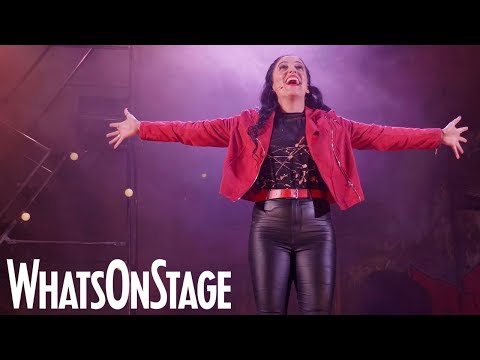
- The show has had a long second life beyond Broadway, including a U.S. tour (2006) and a London production (2019), plus streamed versions in the early 2020s.
Reception
Critics in 2004 tended to agree on one thing: the performers were the main event. The disagreement was about whether the book and score were emotionally honest or emotionally manufactured. That tension is still the best shorthand for the show’s reputation. Some people hear a pop fable that owns its artifice. Others hear a fable that tries too hard to convince you it’s real.
“Its plot a series of showbiz clichés, its music similarly generic.”
“It skillfully manages to convey the material’s doubleness.”
“The kind of show that audiences like, but critics hate.”
Time has softened some of the original hostility because the score’s aims are now easier to read. It isn’t chasing innovation. It’s chasing lift: a street-corner chorus lifting a girl up, then watching the lift strain and wobble. That is why “Once Upon a Time” has endured as the signature: it’s not subtle, but it is structurally honest about what the show is selling.
Technical Info
- Title: Brooklyn (often styled BKLYN)
- Year: 2004 (Broadway opening)
- Type: Pop/rock musical fable with a play-within-a-play frame
- Book: Mark Schoenfeld; Barri McPherson
- Music: Mark Schoenfeld; Barri McPherson
- Lyrics: Mark Schoenfeld; Barri McPherson
- Director (Broadway): Jeff Calhoun
- Music supervision / album production note: John McDaniel is credited as the cast album’s producer in Playbill reporting
- Broadway run: Oct 21, 2004 to Jun 26, 2005; 27 previews; 284 performances
- Venue context: Opened at the Plymouth Theatre (later renamed Gerald Schoenfeld during the run)
- Selected notable placements (within the story): street-corner framing (“Heart Behind These Hands”); Brooklyn’s self-myth kickoff (“Once Upon a Time”); diva battle pressure (“Raven”); father reveal (“The Truth”)
- Cast album: “Brooklyn the Musical: Live!” recorded live before an invited audience; released mid-December 2004
- Label/Distribution: Brooklyn Records; distributed by Razor & Tie
- Availability: Widely available on streaming platforms; licensing available via Concord Theatricals
FAQ
- Is Brooklyn based on a movie?
- No. It’s an original stage musical with a book, music, and lyrics by Mark Schoenfeld and Barri McPherson.
- Who is narrating the story?
- A street performer called the Street Singer leads the City Weeds, who frame the action as a “show” staged under the Brooklyn Bridge.
- What’s the main conflict in the lyrics?
- Fame versus belonging. Brooklyn’s songs chase identity through stardom, while the street-corner material keeps returning to survival, community, and cost.
- What songs should I start with if I want the story fast?
- Try “Heart Behind These Hands,” “Once Upon a Time,” “I Never Knew His Name,” and “The Truth.” That sequence gives you the frame, the dream, the wound, and the confrontation.
- Is the show still produced today?
- Yes, mainly through licensed productions and occasional filmed/streamed events, with the title commonly stylized as BKLYN.
Key Contributors
| Name | Role | Contribution |
|---|---|---|
| Mark Schoenfeld | Book / Music / Lyrics | Co-created the show’s pop-forward score and the street-corner framing concept. |
| Barri McPherson | Book / Music / Lyrics | Co-created the story and lyric voice; the “reconnection” origin story is part of the show’s mythology. |
| Jeff Calhoun | Director | Shaped the Broadway staging language around the City Weeds frame. |
| John McDaniel | Music Supervisor / Cast Album Producer (reported) | Oversaw musical continuity and produced the live cast recording, preserving audience energy. |
| Eden Espinosa | Original Broadway Brooklyn | Originated the title role on Broadway; the score is built around a high-voltage pop belt. |
| Cleavant Derricks | Original Broadway Street Singer | Anchored the framing device as narrator and moral guide. |
| Karen Olivo | Original Broadway Faith | Gave the show its bruised emotional center in the mother role. |
| Ramona Keller | Original Broadway Paradice | Defined the diva antagonist as spectacle, threat, and self-authored legend. |
| Kevin Anderson | Original Broadway Taylor Collins | Played the father as a broken endpoint to the fairy tale’s promise. |
Sources: IBDB; Playbill; Concord Theatricals; CurtainUp; New York Magazine; Broadway.com; Variety; AllMusic; YouTube (Greenwich trailer); university and theatre production listings.